
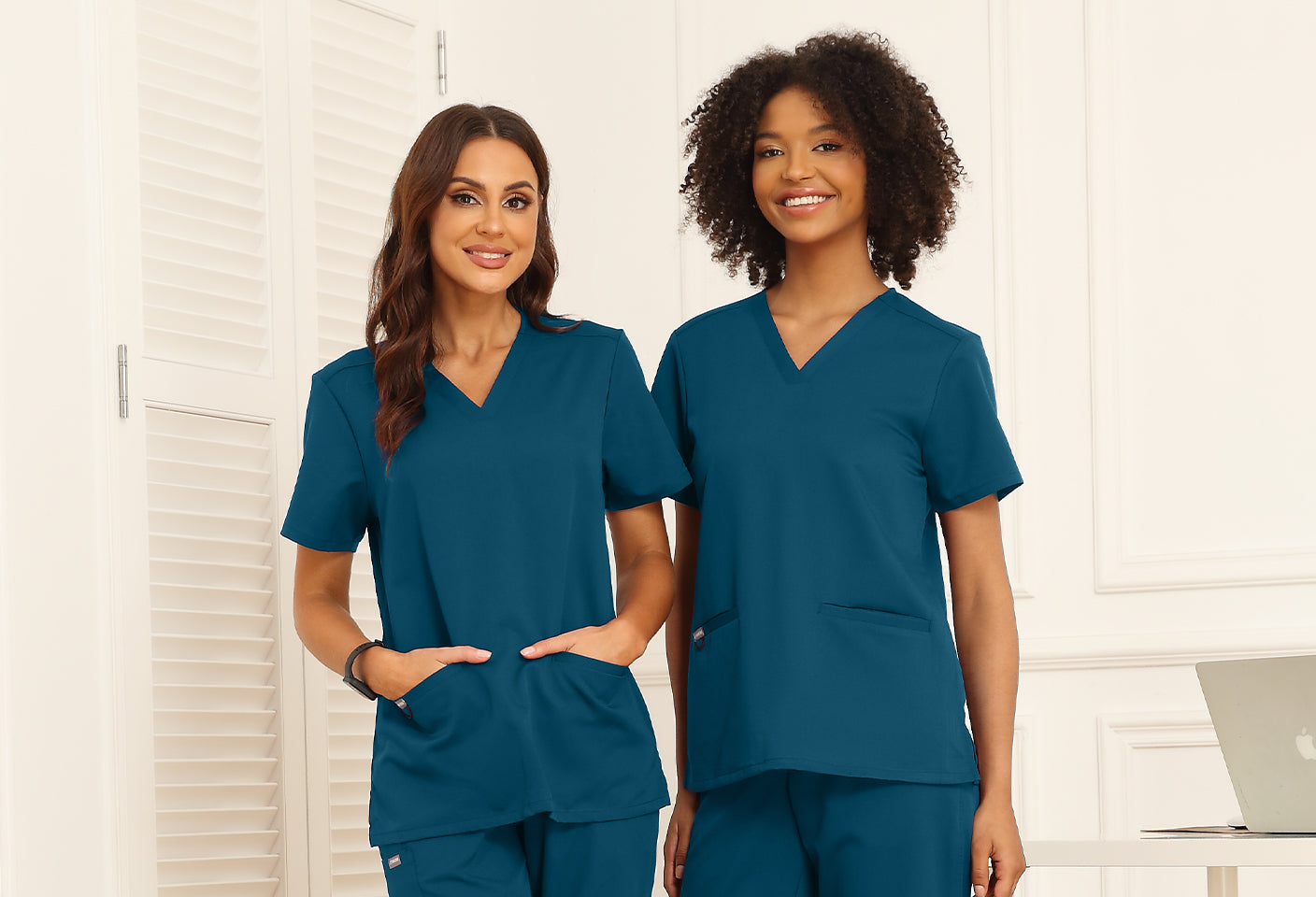

The Everyday Benefits of Better Scrubs
For healthcare workers, every minute counts — whether they're rushing to respond to a patient's call, prepping for surgery, or squeezing in a quick meal between shifts. Scrub suits aren't just a mandatory uniform; they're a daily companion that shapes how smoothly their work and personal lives run. A well-designed scrub doesn't just check the box for dress codes — it eliminates small annoyances, saves precious time, and makes the shift from busy work to daily life feel effortless. Let's break down how thoughtful scrub design supports healthcare workers in both key areas.
1. Workday Efficiency: Designed for Healthcare's Nonstop Movements
Healthcare work is a cycle of constant motion: bending to wrap a patient's bandage, reaching for tools on a rolling cart, twisting to adjust an IV pole, or slipping into a surgical gown in a hurry. Ill-fitting scrubs — too tight in the hips, too rigid in the arms — turn these simple tasks into distractions. Well-crafted scrubs fix this with purposeful features: first, stretchy, lightweight fabrics that move with the body, not against it. This means no pulling at the waist when leaning over a exam table, or no stiffness in the shoulders when lifting a patient's arm to check blood pressure. Second, a two-piece (split) design instead of one-piece styles — this avoids the restrictive feel around the torso, making it faster to layer under surgical gowns and easier to move without fabric bunching. These small tweaks add up: less time adjusting clothes, more time focusing on what matters most — patients.
2. Protection & Disinfection: No Extra Work for Busy Staff
Scrubs need to keep up with healthcare's strict safety rules — especially when it comes to PPE (personal protective equipment) and disinfection. Badly designed scrubs create extra work: fabric that shrinks after high-temperature washes, or loose strings that catch on mask ear loops, or bulky pockets that trap germs. Well-made scrubs avoid these headaches. They use durable fabrics that stand up to weekly high-heat disinfection without fading or losing shape — so staff don't have to replace scrubs every few weeks. They also skip unnecessary details: no decorative patches (which create hard-to-clean crevices), no loose drawstrings (which get tangled in face shields), and smooth necklines that don't rub against N95 masks or get stuck when putting on a surgical cap. The result? Less time re-washing scrubs or fixing tangled PPE, and more time for patient care.
3. Life Beyond Shifts: Smooth Transitions Without Extra Hassle
One of the biggest small frustrations for healthcare workers is the "post-shift switch": having to rush home to change out of scrubs just to pick up groceries, drop off a kid at daycare, or grab a coffee. Well-designed scrubs make this transition seamless with smart, low-key details. Their clean, simple style avoids looking overly "medical" — so staff don't feel out of place stopping at a store or café after work. Hidden pockets add practicality too: during shifts, they hold ID badges and pens securely; after work, they fit a phone or keys, so there's no need to carry an extra bag. Even small touches in pants matter — like slim, tapered cuts (or occasional jogger scrub pants) that skip the bulk of traditional wide-leg scrub pants, making them neat enough for casual outings. These details mean no more wasting time on wardrobe changes; scrubs work as well for post-shift errands as they do for busy shifts.
Why It Matters: Scrubs That Serve People, Not Just Rules
At the end of a long shift, the last thing healthcare workers need is a uniform that adds stress. Great scrubs aren't about looking "perfectly professional" — they're about making hard days easier. Every stretchy thread, every smooth seam, every hidden pocket is a way to respect the long hours, physical effort, and constant focus that healthcare work demands. When scrubs fit how staff work and live, they don't just feel more comfortable — they can pour more energy into the people who need them most: their patients.